
Erin Reeder, Content and Social Media Manager, GrapeSEED US
Julie Baxa, Senior GrapeSEED Trainer, GrapeSEED US
Oral language lays the foundation for the reading and writing skills children will develop as they enter and progress through school. They will use oral language in all aspects of their education, in the classroom as they connect with their peers and teachers, and throughout their lives as they grow into adulthood. Having a solid foundation in oral language will help children become successful readers and strong communicators as well as build their confidence and overall sense of well-being.
When Oral Language Skills Are Missing
In 2002, the National Reading Panel (NRP), a team appointed by George W. Bush to review and summarize scientific evidence on reading and its implications for teaching children to read, published a report naming five components of a reading curriculum that are essential to its success: phonemic awareness, phonics, fluency development, vocabulary development, and comprehension (National Reading Panel, 2002).
This report set the standards for many literacy programs, especially those receiving Reading First federal funding, which were required to follow the guidelines in the report in order to qualify for the funding (Gamse, Bloom, Kemple, & Jacob, 2008). However, many English language arts scholars believed other critical components, such as oral language development, had been left out (Garan, 2001; Krashen, 2001; National Education Association, 2013).
Lily Wong Fillmore and Catherine Snow, language and literacy researchers and authors of the first chapter of the book What Teachers Need to Know About Language , tell us that, “Oral language functions as a foundation for literacy and as the means of learning in school and out” (Fillmore & Snow, 2002). However, oral language development is often missing from reading and writing programs, leaving teachers to wonder why their students are still struggling or taking longer than expected to become proficient speakers and readers.
While the essential components listed by the NRP all contribute to a successful literacy program, if children do not have a solid foundation in oral language, communicating effectively and learning to read can be a long and difficult process. “Children’s speaking and listening lead the way for their reading and writing skills, and together these language skills are the primary tools of the mind for all future learning” (Roskos, Tabors, & Lenhart, 2009).
The Challenge Presented by the Word Gap
Oral language proficiency has a major impact on students. All standardized testing in the United States is done in academic or standard English, therefore, children whose personal language is not an academic language are at a disadvantage. Children need to be able to speak academic oral language in order to become successful learners and readers in the classroom while their personal language is still valued and maintained.
In 1995, child psychologists Betty Hart and Todd R. Risley from the University of Kansas published the results of their oral language development study (Hart & Risley, 1995). They wanted to try to determine why preschool-aged children from low-income homes did not perform as well in school at the age of nine as their economically advantaged peers. They recorded and analyzed the words spoken between parents and children one hour a month over a period of two and a half years. What they found was astonishing. By the age of three, there was a large gap between children whose parents provided rich language experiences, such as talking to children, singing, reading, and so on, and children who grew up with fewer languages experiences at home. Children with rich language experiences heard about 45 million words compared to the latter group of children who heard only 13 million words.
This 30 million word gap (2003) presents a problem for classroom teachers across the country in today’s high-stakes educational environment. The students are not starting out on an even playing field, and teachers are charged with the responsibility of getting the children who are behind caught up and reading at grade level. The good news is, just like math and science, academic oral language can be taught.
Building a Foundation in Oral Language
Again and again research shows that repeated exposure to rich language can help children become successful communicators, readers and writers (Simmons & Kameenui, 1998; Himmele, 2009). Educating parents on the importance of oral language and encouraging them to communicate and read with their children as early as possible can help prepare them for school.
Additionally, providing students with high-quality early childhood education enriched with a supplemental program promoting oral language and literacy development can help young students become proficient readers by third grade.
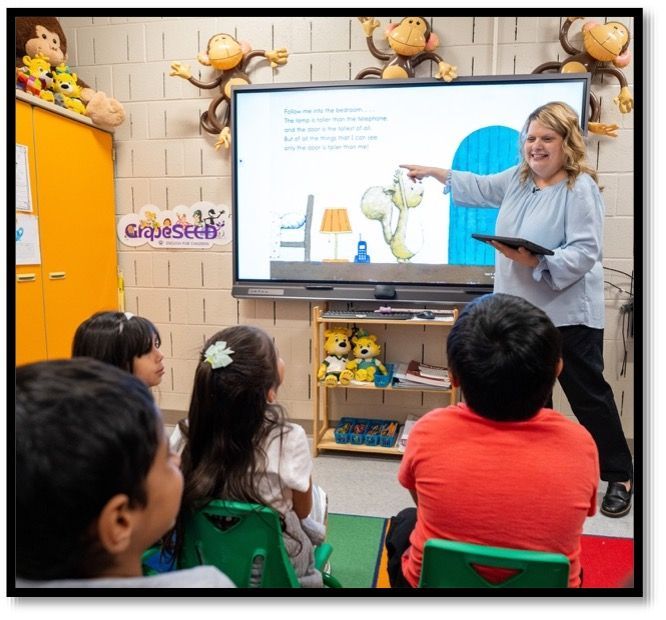
GrapeSEED is a research-based oral language acquisition and critical listening program that is helping 4 to 8-year-old students close the achievement gap in oral language. The program supplements existing Language Arts and Literacy curricula and is proven to help students develop into proficient readers by third grade. It is used in a variety of settings, including early childhood classrooms, Response-to-Intervention (RTI) initiatives, Title programs for struggling learners, ESL/ELL classrooms, as well as with subgroups of students struggling with oral language.
Oral language and critical listening is the heart of the GrapeSEED program for young learners. A focus on building these essential skills is one of the reasons the program is so successful and sets it apart from other literacy programs. Through carefully designed multi-sensory materials, GrapeSEED keeps children engaged and helps them learn oral language naturally. As a result, independent research showed that GrapeSEED students reached proficiency in speaking and reading faster than the national average (Smith & Smith, 2014).
Reading proficiency by the end of third-grade can predict a child’s success in school and in life (Donald Hernandez, 2011). Stephen Covey, an educator and author, states that we should, “Begin with the end in mind” (Covey, 1990). If we want to give our children the best chance to graduate high school and become successful contributors to society, we must start as early as possible in their young lives. We must give them a solid foundation in oral language to build upon.
References
Covey, Stephen (1990). The 7 habits of highly effective people. New York City, NY: Free Press.
Fillmore, Lily W. & Catherine E. Snow (2002). What Teachers Need to Know about Language. McHenry, IL: Delta Systems.
Gamse, Beth C., Howard Bloom, James J. Kemple, Robin Tepper Jacob (2008). Reading First Impact Study: Interim Report. Retrieved from MDRC website: http://www.mdrc.org/publication/reading-first-impact-study.
Garan, Elaine (2001). Beyond the Smoke and Mirrors: A Critique of the National Reading Panel Report on Phonics, Phi Delta Kappan , volume 82, pp. 500-506.
Hart, B. & T. R. Risley (1995). Meaningful differences in the everyday experience of young American children. Baltimore, MD: Paul H. Brookes.
Hart, B. & T. R. Risley (2003). The early catastrophe: The 30 million word gap by age 3. American Educator , Spring 2003, 4-9.
Hernandez, Donald (2011). Double Jeopardy: How Third-Grade Reading Skills and Poverty Influence High School Graduation. Baltimore, MD. Retrieved from The Annie E. Casey Foundation website: http://www.aecf.org/resources/double-jeopardy/.
Himmele, P. & W. Himmele (2009). The Language-Rich Classroom: A Research-Based Framework for Teaching English Language Learners (pp. 30–33). Alexandria, VA: ASCD.
Krashen, Stephen D. (2001). More Smoke and Mirrors: A Critique of the National Reading Panel (NRP) Report on “Fluency”. Phi Delta Kappan , vol. 83, pp. 119-23.
National Reading Panel (2002). Teaching Children to Read: An Evidence-Based Assessment of the Scientific Research Literature on Reading and Its Implications for Reading Instruction. Rockville, MD;
Roskos, Kathleen A., Tabors, Patton O., & Lenhart, Lisa A. (2009). Oral language and early literacy in preschool: Talking, reading, and writing. Newark, DE: International Reading Association
Simmons, & Edward J. Kameenui. (1998). What reading research tells us about children with diverse learning needs: Bases and basics. Mahwah, NJ: Erlbaum.